Sep
16
I stumbled upon Alex Cornell’s Wes Anderson Film Festival works and I love his style. His works really standout that I just can’t not feature him in our blog! Luckily, I had the chance to interview this talented young graphic designer from San Francisco.
Could you tell us something about yourself?
I am 24, about to turn 26 (we skip 25 where I’m from to avoid the stress). I am currently living in San Francisco, getting my MFA in design, working and writing for ISO50, freelancing, and running an intermittent solo music career. I went to Duke for my undergrad and studied psychology. I don’t recall doing much work, but I think I may have just forgotten about it with expert use of selective memory. Most of my time at school was spent playing guitar and singing in a band called Running Lights.
What and who are your influences?
For me, first and foremost would be Scott Hansen (ISO50). Before I even knew what graphic design was, I was following Scott’s work. Scott is able to move between both music and design, and create incredible work in both fields. As these are the same two creative arenas I find myself in, he has always been a major source of inspiration and someone to look up to. Otherwise, I would say I am influenced by the design
of Build or Non-Format, the writings of Michael Beirut, and the irreverence of Stefan Sagmeister. And the entire country of Japan. Also John Mayer – I probably built the entire first couple versions of myself around what I thought John Mayer might do.
How do you work on a concept? I try and think about: A) what hasn’t or isn’t being done, B) what would make me laugh, C) what would be the worst possible idea, and D) what is practical (and/or what I can make practical in short order). I will usually just sit and think for about 30 minutes and try and think of ideas. Usually, this is enough to grab some concept but not anything visual. The visual brainstorming is a lot harder and usually takes way more time. This process begins alone, like my conceptual brainstorm, but ends up with me surrounded by piles of books, movies, etc. Each and every time I begin a new project I am frozen with fear that I won’t be able to think of anything good. Every single time.
I really like your works for your hypothetical Wes Anderson Film Festival . Could you tell us about it?
I made the materials for the hypothetical festival over the course of a 15-week semester. Much of the finished product work was completed in a short amount of time, once I had nailed down a visual style and look/feel (after about 4 weeks). It was a fairly smooth process of development actually –much more so than I had become accustomed to. I really enjoyed being able to wield a certain amount of weirdness and randomness throughout the project. For example, I had a lot of fun titling every piece of the project something very long and unusual. There was no single name for the festival because this seemed tired and expected. Instead, each time the brand is encountered, there is a different (but equally) bizarre headline.
That’s a well-polished work for a class project. I will ask you questions that we ask all our designers. To you, what makes a good package?
A good design must be intuitive and simple, first. After that, if it can also be strange, beautiful and exciting than you have a great success. This balance is very important. I also gravitate towards packages implementing really tactile materials. There are magazines that I read because I like the way the pages feel. I force myself to enjoy the content as well so I can hold the paper longer.
Well said. Now, what makes a bad package?
If it attacks you, like clamshell packaging, this would be a good indicator of a “bad” package. Also, bad graphic design can ruin even the best physical package designs.
Thanks a lot for sharing your talents and brilliant mind, Alex. We can’t wait to see more of your designs. Keep it up!
Jan
20
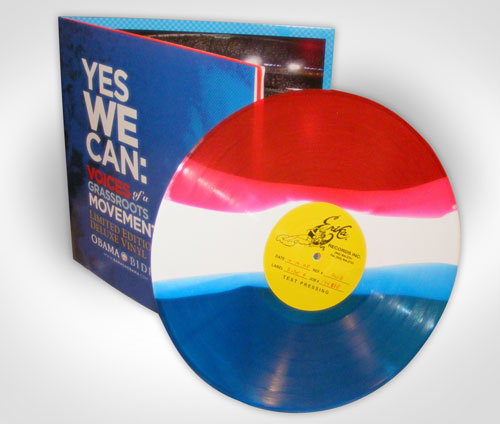
Barack Obama, in his wisdom, working with the Democratic National Committee, chose Unified Manufacturing to produce the Yes We Can: Voices of a Grassroots Movement record.
That choice means the album is in the hands of an experienced, energetic team of industry veterans working to fulfill the vision of the new President. And fulfill it they did, as the final product’s creativity, patriotism, and significance is only rivaled by the man himself.
Working with Hidden Beach Records and the Barack Obama campaign, Unified Manufacturing spent countless hours ensuring the record is created of the highest quality and attention to detail. The record’s greatest feature is the beautiful red, white, and blue colored vinyl disc, which is left slightly translucent. Innovative and unique, it is truly one of a kind.
The disc is packed with legendary artists including Stevie Wonder, Lionel Richie, Kanye West, John Mayer, Sheryl Crow, and more. Dale Zoerker of Digital Lava supplied his talent for the project’s beautiful artwork.